
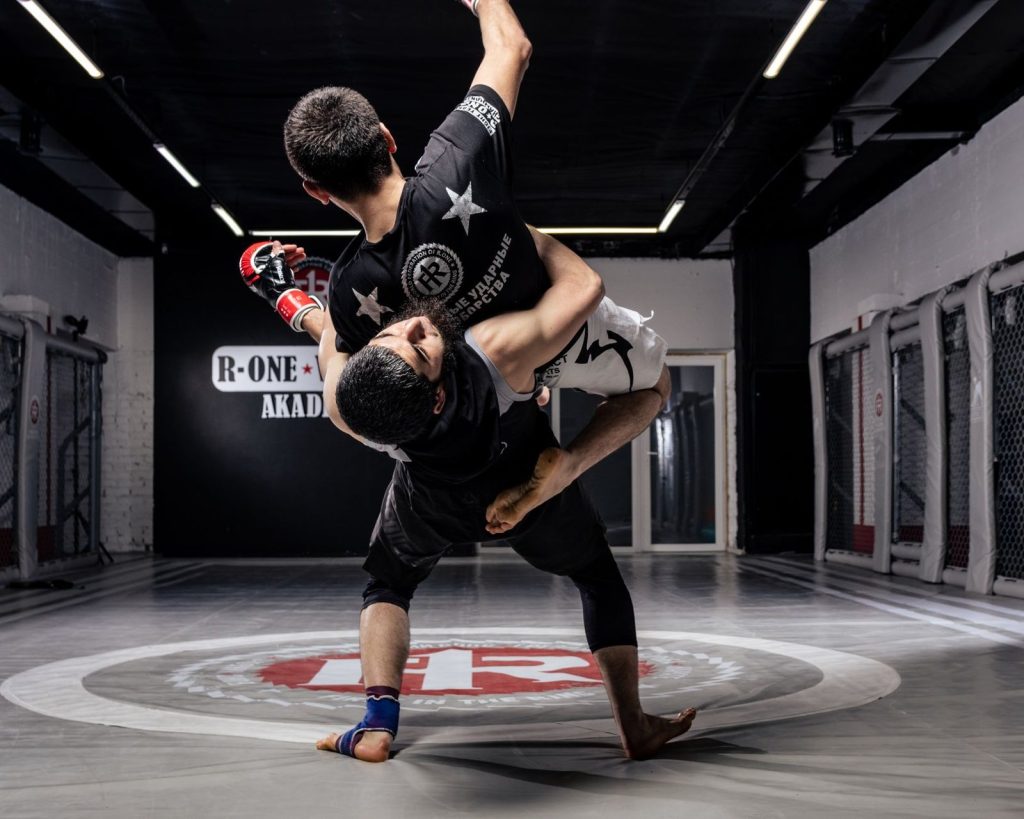
In short
- The single leg attacks one of your opponent’s legs, lifting or trapping it to take away their base.
- It can be shot from farther out than a double leg and chains naturally into it.
- The finish matters more than the entry, and there are a dozen variations.
- Against the cage it becomes a grinding takedown, often decisive over a round.
- Recommended level: after the double leg and the sprawl.
The single leg is forgiving: you only need one leg, so an imperfect entry can still work. From there it opens a sequence of options that the best wrestlers in the UFC chain together without pause, until the opponent, hopping on one foot and fighting for their leg, finally goes down.
The principle
You attack one leg, usually the lead leg, control it with both hands, then take the opponent down by removing their base. Where a double leg goes through the opponent, a single leg works on angles: you step off their line and off-balance them toward the side where they no longer have a leg to catch themselves.
Entries
From range
Change levels as for a double leg, but step to the outside of the target leg. The head goes against the inside or outside of the thigh depending on the variation.
Off a kick
In MMA, many singles come from a caught kick. The opponent throws a low or body kick, you trap it against your body, and you are already in single leg position. That is one reason strikers facing wrestlers get cautious about kicking.
From the clinch
Against the fence, one hand drops to the knee while your head pins the opponent to the cage. This is the most common entry in the UFC, because the cage limits escape routes.
Finishes
| Finish | Movement |
|---|---|
| Running the pipe | Head on the thigh, run in an arc while pulling the leg down |
| Inside trip | Keep the leg and sweep the standing leg with your foot |
| Lift | Raise the leg to hip height and drive the opponent back |
| Switch to a double | The opponent defends by backing up, you release a hand and grab the other leg |
| Go behind | Circle behind the leg to take the back |
The switch to a double is the one to remember. A wrestler who flows from one attack to the next forces the opponent to defend two threats at once. The takedowns of Khabib Nurmagomedov and Merab Dvalishvili rely on exactly that: chaining attacks rather than landing the first one.
Against the cage
With their back to the fence, the opponent cannot retreat or sprawl, but can use the cage for balance and throw elbows at the attacker’s head. The answer is to keep your head up, tight against their chest or shoulder, pull the leg away from the fence to take away their support, and keep switching finishes. It is exhausting for both fighters, and it scores with the judges even when the takedown does not land, since cage control counts.
Defenses
- the sprawl, if you see it early;
- the whizzer, an overhook on the attacker’s shoulder to flatten them and free the leg;
- the guillotine or head control when the attacker leaves the head outside.
MMA adds one more: strikes. As long as the attacker holds a leg without finishing, their head is open to elbows and punches.
Frequently asked questions
Should I learn the single leg or the double leg first?
The double leg, in most gyms. It builds the level change and penetration step that the single leg then reuses.
What is running the pipe?
A single leg finish where the attacker, head on the opponent’s thigh, runs in an arc while pulling the leg to the mat until the opponent falls sideways.
Can you catch a kick for a single leg?
Yes. Catching a low kick or body kick and turning it into a single leg is one of the most effective entries in MMA.