Key Takeaways
- Closed guard means trapping the opponent between your legs from the bottom, with your ankles locked.
- It is one of the few offensive positions available from the bottom: the triangle, kimura and armbar come naturally from it.
- The practitioner has all four limbs available, while the opponent on top only has two arms: a real structural advantage.
- Charles Oliveira, Brian Ortega and Demian Maia are among its most dangerous users in modern MMA.
- Staying in closed guard too long without looking for a transition is a tactical mistake: the position remains dangerous even when well mastered.
What Is Closed Guard?
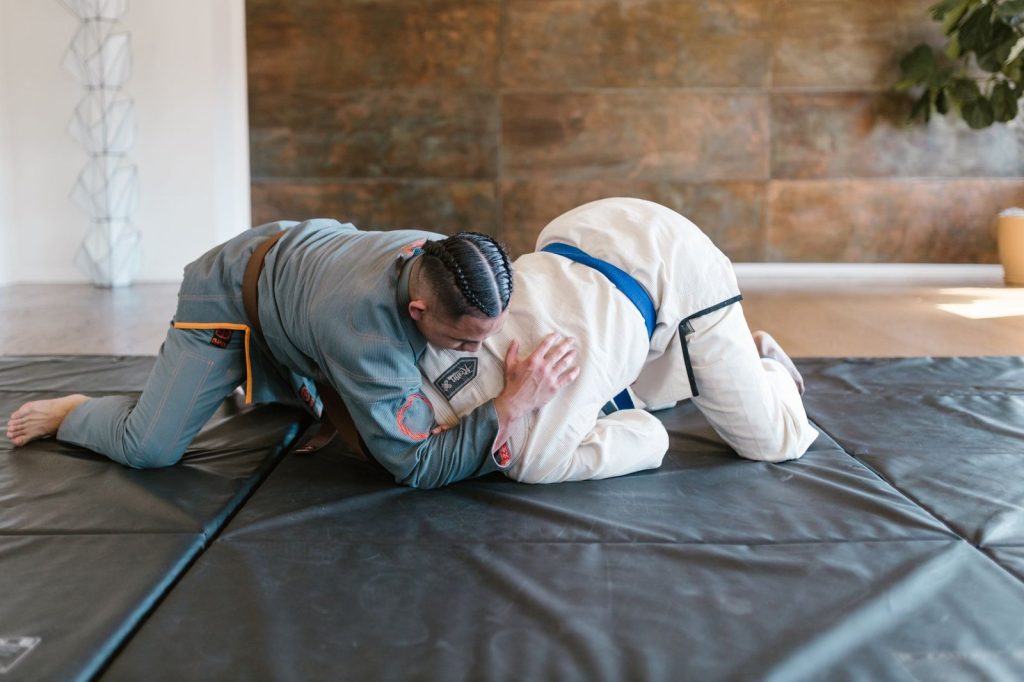
Closed guard, also called full guard, is one of the fundamental positions in BJJ and grappling, and one of the most important to master in MMA. It consists of lying on your back while wrapping your legs around the opponent’s torso, with your ankles crossed behind their back to lock them in.
What sets closed guard apart from most ground positions is that it is both defensive and offensive from the bottom. A practitioner who has mastered it is in a position to act, with direct use of all four limbs while the opponent on top only has their arms.
Biomechanical Principle
Closed guard relies on a simple principle: the bottom practitioner’s legs encircle and control the opponent’s torso, limiting their mobility and striking angles. The ankles crossed behind the opponent’s back form a lock that they cannot break with brute force: they have to open the guard with technique.
This position creates an imbalance in the use of limbs: the bottom practitioner uses both arms and both legs to control and attack, while the opponent on top only has access to their two arms, since their legs are blocked or unusable for striking. This structural imbalance is what makes closed guard an offensive position despite being on the bottom.
Execution and Managing the Position
- Lock the guard. With your back on the mat, trap the opponent between your legs and cross your ankles behind their back to pin them. The opponent is on their knees, torso caught in a vise. Leave no space: a loose lock lets the opponent open the guard easily.
- Control the upper body. Use your hands to control the opponent’s arms: underhook, overhook, or a grip on the biceps. This control limits striking angles and opens up submission opportunities. If the opponent tries to posture up to throw ground and pound, pulling them in reduces the gravity behind their strikes.
- Read the situation and act. From closed guard, you have three options: attempt a submission if the opportunity arises, work to get back to your feet, or transition to a more favorable position (half guard, back take, sweep). Staying passive in closed guard without pursuing one of these three exits is a tactical mistake.
Main Attacks From Closed Guard
Triangle choke. The most natural attack from closed guard. If one of the opponent’s arms ends up isolated during an exchange or a strike attempt, the triangle follows directly from the position. It is one of the smoothest transitions in BJJ.
Kimura. Grabbing the opponent’s wrist from closed guard leads directly to the Kimura grip, which is especially available when the opponent posts a hand on the mat to stabilize themselves.
Armbar. From closed guard, by controlling one of the opponent’s arms and pivoting the body 90°, the armbar becomes a third direct threat. The triangle / kimura / armbar combination from the same position forces the opponent to defend three different submissions at once.
Common Mistakes
- Not crossing the ankles. Leaving your legs simply resting without a lock gives the opponent the space they need to open the guard without effort. Crossing and squeezing the ankles is the absolute foundation of the position.
- Not controlling the upper body. Letting the opponent posture up freely allows them to strike from a high posture, where gravity amplifies every blow. Constantly pulling them in limits this angle and keeps them in a poor posture for ground and pound.
- Settling into closed guard without looking for an exit. Closed guard is still a position where the opponent is on top: it looks bad to the judges and can become risky if the opponent manages to open the guard. Without an active submission threat or an attempt to get up, the position becomes unfavorable over time.
Defenses From the Top
- Open the guard to pass. The main goal from the top is to break the ankle lock, get out of closed guard and move to a more dominant position (side control, mount). This opening is done with technique, while staying alert to the risk of a triangle if an arm ends up isolated during the attempt.
- Get to your feet. Standing up in closed guard while pressing on the opponent’s knee lets you add weight and pressure, making it easier to open the guard. Be careful, however, not to leave your ankles within reach of the bottom fighter, who can grab them to launch a leg attack.
Variations and Transitions
Transition to the omoplata. By pivoting 180° from closed guard while controlling one of the opponent’s arms, you switch directly to the omoplata, a shoulder submission by external rotation that is hard to defend at the same time as the classic closed guard threats.
Kimura / Tarikoplata. The Kimura grip from closed guard leads to the classic Kimura or to the Tarikoplata, a variation in which the grip is kept to take the back while maintaining the shoulder lever.
Back take. If the opponent on top leans forward too much or if a sweep partially succeeds, closed guard can serve as a springboard to get behind the opponent and take the back, one of the most dominant positions in MMA.
Fighters Who Made Their Mark With It
Charles Oliveira: the Brazilian lightweight champion uses closed guard as an offensive hub, chaining submission attempts with a fluidity that forces his opponents to defend constantly, even from the top.
Brian Ortega, “T-City,” is one of the most feared finishers in the UFC. His closed guard is especially dangerous because he combines it with a triangle and a rear naked choke from the bottom of rare precision, capable of surprising opponents who are in a dominant position.
Demian Maia, a Brazilian BJJ specialist, took grappling in MMA to a systematic level. His closed guard is a tool for control as much as for submissions, built on a deep understanding of leverage and transitions.
Famous Examples in Competition
- Antonio Rodrigo Nogueira vs. Mirko “Cro Cop” Filipovic, Pride Final Conflict (2003). Nogueira, dominated on the ground and absorbing heavy strikes, stayed active from his closed guard and eventually submitted Filipovic, an iconic demonstration of how dangerous a guard expert remains from the bottom.
- Frank Mir vs. Brock Lesnar I, UFC 81 (2008). Mir used his closed guard to control the massive Lesnar and launch an armbar from the bottom, a perfect illustration of the principle that technique outweighs raw physical power.
- Demian Maia vs. Chael Sonnen, UFC 95 (2009). Maia neutralized Sonnen by keeping him in his closed guard and submitting him with a triangle choke, showing that an active, well-built closed guard can contain even a high-level wrestler.
FAQ
Is Closed Guard a Good Position in MMA?
Yes, as long as you stay active. A passive closed guard (with no submission threat or transition attempt) looks bad to the judges and leaves the initiative to the opponent on top. An active closed guard, on the other hand, with regular submission attempts and good control, is a formidable offensive position even from the bottom.
How Do You Get Out of Your Opponent’s Closed Guard?
From the top, the goal is to break the opponent’s ankle lock with a guard-passing technique: pressure on the thigh, moving to half guard, or standing up to use your body weight. Every attempt must come with close attention to your arms: an arm isolated during the transition becomes a target for the triangle or the armbar.
What Is the Difference Between Closed Guard and Half Guard?
In closed guard, both legs encircle the opponent’s torso and the ankles are locked: the opponent is completely trapped between the legs. In half guard, a single leg controls one of the opponent’s legs (usually at the knee or ankle): control is partial, but mobility is greater on both sides. Half guard is often a transition between closed guard and other positions.
Can You Strike From Closed Guard?
Yes. From the bottom, elbows to the sides of the opponent’s head, short uppercuts or strikes to the back of the head (within the limits of the rules) are possible. These strikes are generally not decisive, but they serve to distract the opponent, keep them from focusing only on passing the guard, and create openings for submissions.
Conclusion
Closed guard is an essential position in MMA, for grappling specialists and for any practitioner who wants to be complete on the ground. It requires an understanding of control, patience in reading the opponent, and the ability to chain submission threats to stay dangerous from the bottom. Mastering closed guard means you always keep the ability to act, even with your back on the mat.
To avoid ending up in your opponent’s guard, you also need to know how to defend takedowns: the sprawl is the foundation.