
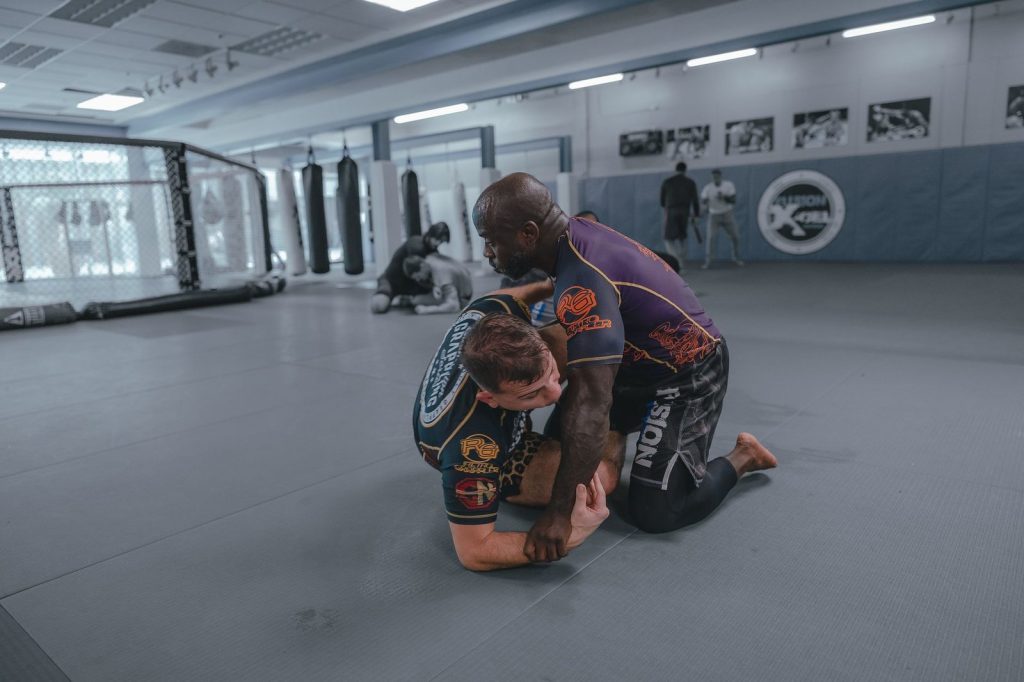
In short
- The double leg means grabbing both of your opponent’s legs and driving them to the mat.
- Three phases: level change, penetration step, finish.
- In MMA it has to be set up with strikes, or your opponent sees it coming.
- The most common mistake is dropping your head and looking at the mat.
Want to put people on their back? The double leg is the first takedown to learn. Simple to understand, hard to do well, and it works from a first wrestling class all the way to title fights.
What a double leg is
You get under your opponent’s guard, wrap both arms around both legs behind the knees or thighs, and take them down by driving forward, without pulling. Almost all the work comes from your legs and your footwork, not your arms.
The three phases
1. Level change
Before you shoot, you drop. Bend your knees so your hips go below your opponent’s hips, and keep your back straight. If you bend at the waist instead of the knees, you are already late. Head up, eyes on your opponent’s chest, so you can still see the hands.
2. Penetration step
This is the heart of it. Your lead leg steps deep between your opponent’s feet, and your back knee drops close to the mat, or onto it for a blast double. Your shoulder hits the hip or stomach, your head goes to the side, tight against the ribs. Your hands lock behind the thighs or the knees.
3. The finish
- Keep driving, bring your back leg up and push at a diagonal, back and to the side.
- Cut the corner: your head pushes one way while your arms pull the legs the other.
- Lift and dump, if you have the position and the strength. It looks great and costs the most energy.
Once they are down, don’t stay in their legs. Move straight to a control position: half guard, side control, or the back if they turn.
What changes in MMA
In wrestling you can shoot from range. In MMA your opponent has fists, knees and elbows, and an unprepared shot can eat a knee to the face. So set it up. A jab, a cross, a punch feint: the hands come up, and that is when you change levels. Georges St-Pierre made this his signature, with a punch-to-double-leg timing few have matched.
The cage changes things too. Against the fence, your opponent cannot back up to sprawl, and many MMA doubles end by pinning the opponent to the cage and sliding them down. That grinding style made Khabib Nurmagomedov famous.
Mistakes to fix first
| Mistake | What happens | Fix |
|---|---|---|
| Head down, eyes on the mat | You give up the guillotine and your balance | Head up, eyes on the chest |
| Bending at the waist | They see it coming and sprawl | Bend the knees, then shoot |
| Short penetration step | You end up in front of them, not under them | Lead foot deep between their feet |
| Pulling with the arms | You gas out and they resist | Drive with the legs, finish on a diagonal |
| Shooting from too far | They have time to back away | Close the distance with strikes first |
Drills
- Shadow wrestling: level changes and penetration steps in the air, ten per side, head up.
- Partner reps with no resistance: shoot, finish, stand, repeat. Smoothness before speed.
- Progressive resistance: your partner defends at 30 percent, then 50, then more.
- Setups: jab to double, cross feint to double, on pads your partner drops at the last moment.
Wear knee pads if you drill on a hard surface, and learn the main defense at the same time: the sprawl.
Frequently asked questions
What is the difference between a double leg and a single leg?
A double leg attacks both legs, a single leg only one. The double finishes more directly; the single can be shot from farther out but needs a longer finish.
Is the double leg good for beginners?
Yes. It is one of the first takedowns taught in wrestling and MMA, and its mechanics carry over to every other shot.
What is a blast double?
An explosive double leg shot fast and low, back knee on the mat, to knock the opponent over before they react. It is often used as a counter when the opponent steps forward.
How do I avoid the guillotine on a double leg?
Keep your head up and to the side, against your opponent’s ribs, never in front of their stomach.