
Key Takeaways
- The Rear Naked Choke (RNC) is a blood choke applied from back control, targeting the carotid arteries.
- The “V” grip formed by the biceps and forearm compresses both sides of the neck at the same time.
- When applied correctly, it can cause a loss of consciousness within seconds.
- Khabib Nurmagomedov, Charles Oliveira and Brendan Allen are particularly dangerous users of it.
- Several variations exist: the standing RNC, the jaw crush, and the collar choke in the gi.
What Is the Rear Naked Choke?
The Rear Naked Choke, also called the Back Choke or simply the RNC, and mata leão (“lion killer”) in Brazilian BJJ culture, is probably the most feared submission in MMA. Applied from back control, it leaves the opponent no angle to attack in return: the fighter on the receiving end is completely exposed, unable to strike or escape easily.
Its reputation comes from its raw effectiveness: a well-applied RNC works within seconds, regardless of the opponent’s size or physical strength. It is one of the few techniques where resisting can make things worse for the person caught in it.
Biomechanical Principle
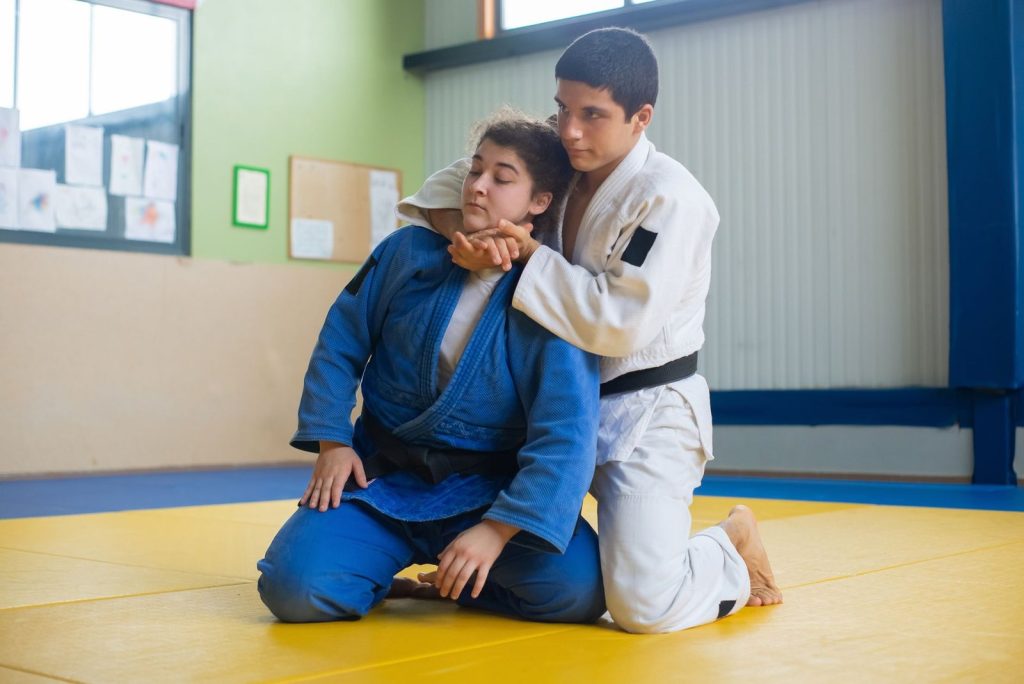
The RNC is a blood choke: it compresses the carotid arteries on each side of the neck, instantly reducing blood flow to the brain. The attacker’s forearm acts like a tourniquet, while the biceps and forearm form a “V” that seals both sides of the neck at the same time.
The crook of the elbow sits under the chin and never on the trachea, which is what separates a blood choke from an air choke. The opposite hand, placed on the back of the opponent’s head, serves as a brace to close the vise. Pressure spread correctly between both sides of the neck is enough to cause a loss of consciousness within seconds.
Execution From Back Control
- Establish back control. Once on the opponent’s back, keep your chest glued to their back: any gap reduces control. Place your arms in the “seat belt” position (one arm over the shoulder, the other under the opposite armpit) and set your leg hooks to pin down the lower body.
- Set the choke. Shift to the side of the arm you want to choke with. With that arm, slide the elbow under the opponent’s chin until it lines up with the center of the neck, then grab the biceps of the opposite arm.
- Place the bracing hand. The hand of the opposite arm goes to the back of the opponent’s head, palm flat on the skull and never on the nape of the neck, which would reduce the pressure.
- Finish. Squeeze your elbows toward each other while driving your hips forward. The hips generate the final power along with the arms. The hip movement “pushes” the opponent’s head into the V formed by the arm.
Common Mistakes
- Misaligned elbow. Not sliding the arm in far enough for the elbow to line up with the opponent’s chin. An elbow that is too high or too low compresses the trachea instead of the carotids: the choke is painful but much less effective.
- Using only arm strength. As with most BJJ submissions, the finish should involve the whole body. Driving the hips forward is the main engine; the arms guide and hold.
- Losing chest-to-back contact. Leaving space between your chest and the opponent’s back reduces overall control and allows them to turn and attempt an escape.
Main Defenses
- Defend the choking arm first. As soon as the opponent tries to set the RNC, grab their choking arm with both hands and try to pull it away from your chin before it closes. If the choke is already in place, the priority shifts to the arm behind your head, since that is the one closing the vise.
- Clear the leg hooks. Getting your legs out of the opponent’s hooks reduces their overall control and opens up the possibility of turning or rolling over to reverse the position.
Notable Variations
Collar choke (gi). In BJJ with a gi, the lapel of the collar can replace or complement the forearm to apply carotid pressure: the grip is different but the biomechanical principle stays the same.
Jaw crush. When the opponent defends by tucking the chin to block the elbow from entering, some practitioners apply pressure to the jaw to force the head up and create the space needed to set the RNC.
Standing Rear Naked Choke. A standing variation, often used late in a fight or from a clinch situation. It is less stable because the opponent can still move, but it is dangerous if the back control is solid.
Fighters Who Made Their Mark With It
Khabib Nurmagomedov: his wrestling system allowed him to consistently take opponents to the ground and work his way to back control. The RNC was the natural conclusion of his control game, made almost inevitable once he had the back.
Charles Oliveira: the Brazilian is one of the greatest finishers in UFC history. His RNC is especially feared because he launches it from fluid transitions, often in the middle of a standing exchange or during reversals on the ground.
Brendan Allen: a grappling specialist, he uses the RNC as the culmination of a methodical back-taking system, chaining back takes from guard and side control.
Famous Examples in Competition
- Khabib Nurmagomedov vs. Conor McGregor, UFC 229 (2018). Khabib took McGregor’s back in the fourth round and set the RNC with surgical precision, forcing the Irishman to tap in one of the most anticipated fights in UFC history.
- Miesha Tate vs. Holly Holm, UFC 196 (2016). Tate dethroned the reigning champion by taking her back from the ground in the fifth round and applying the RNC, one of the most spectacular comebacks in the women’s division.
- Charles Oliveira vs. Dustin Poirier, UFC 269 (2021). Oliveira weathered a difficult start before completely turning the fight around, finishing it by RNC in the third round and confirming his status as the reigning lightweight champion.
FAQ
Is the Rear Naked Choke Dangerous in Training?
Like any blood choke, the RNC can cause a rapid loss of consciousness if the partner does not tap in time. It is essential to work progressively, release immediately at the first tap, and never apply maximum pressure on an unprepared beginner. In a structured training environment, it is a safe technique.
Why Should the Elbow Line Up With the Chin Instead of the Throat?
An elbow placed on the trachea produces an air choke: painful, but slow and less effective in competition. Lining it up under the chin lets the crook of the elbow sit at the center of the neck, leaving the biceps and forearm to compress the carotids on both sides: the effect is immediate and does not depend on the opponent’s pain tolerance.
Can You Apply an RNC on a Bigger or Stronger Opponent?
Yes. Once back control is established and the technique is set correctly, the physical balance of power becomes secondary. Carotid compression works the same way regardless of the opponent’s size, which is exactly what makes the RNC so feared at every level of competition.
What Is the Difference Between the Seat Belt and “Two Hooks” Back Control?
The seat belt refers to arm control (one arm over the shoulder, the other under the armpit), regardless of leg position. The hooks refer to the legs placed in front of the opponent’s thighs. Together, the two make up full back control: the seat belt controls the upper body, and the hooks pin down the lower body. The RNC can technically be set without hooks, but control is much less stable.
Conclusion
The Rear Naked Choke is the benchmark submission in MMA: effective, fast, applicable regardless of size, and nearly impossible to defend once properly set. Mastering it depends above all on the quality of your back control: without a solid back take, no RNC can succeed. Working on the back take, the hooks and the seat belt is what makes the finish come naturally.