In short
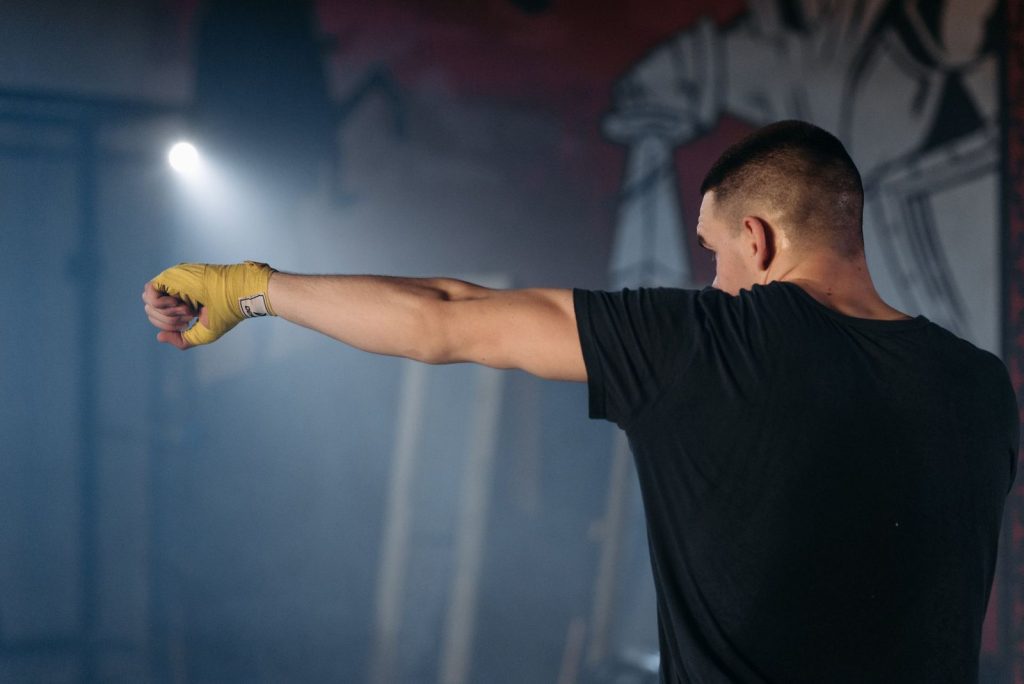
- The jab is the straight punch thrown with the lead hand.
- It measures distance, disrupts the opponent and sets up everything else.
- MMA stances are lower and wider than boxing stances because of takedowns.
- It goes out fast and comes back faster, chin tucked behind the shoulder.
The jab rarely knocks anyone out. That is not its job. It finds the range, blocks the opponent’s vision, breaks their rhythm and opens the way for the rear hand or a takedown. Whoever controls the jab usually controls the distance.
The basic movement
From your stance, the lead fist travels in a straight line to the target. The elbow stays behind the fist, the fist turns palm-down at the end, and the lead shoulder rises to cover the chin. Your weight shifts slightly onto the front foot, with a small step if you need the range. The rear hand stays glued to your face.
The return matters as much as the punch. Bring the fist back on the same line, faster than it went out. A jab that hangs invites a counter or a wrist grab.
Boxing vs. MMA
| Boxing | MMA | |
|---|---|---|
| Guard | high and tight | lower and wider, to defend the legs |
| Stance | on the balls of the feet | more planted, ready to sprawl |
| Gloves | 10 to 16 oz | 4 oz, less to hide behind |
| Main risk | the counter | the counter, the takedown and the low kick on the lead leg |
Variations
- The double jab: two in a row, the second a little longer. The first makes the guard react, the second lands.
- The body jab: bend your knees, not your waist, and aim at the solar plexus. It looks like the start of a takedown, which makes it hard to read.
- The pawing jab: short, light and repeated, to blind the opponent. Georges St-Pierre used it to control stronger opponents, notably Josh Koscheck in 2010.
Combinations off the jab
- Jab, cross: the simplest and most used combination in MMA.
- Jab, low kick: the jab raises the guard, the kick lands on the lead leg.
- Jab, feint, takedown: the hands come up and you change levels for a double leg.
Common mistakes
| Mistake | Result | Fix |
|---|---|---|
| Flaring elbow | Telegraphed and slow | Elbow behind the fist |
| Chin up | Rear-hand counter | Lead shoulder to the chin |
| Rear hand dropping | Open to the hook | Rear hand on the face |
| Slow return | Wrist grabbed, countered | Return on the same line, faster |
Frequently asked questions
What is the jab used for in MMA?
To manage distance, disrupt the opponent and set up other strikes or a takedown. It is rarely a finishing punch, but often the most thrown.
Should you turn your fist on a jab?
Yes, palm-down at the end of the punch. It protects the wrist and lifts the shoulder in front of the chin.
Why is the guard lower in MMA than in boxing?
Because fighters must defend takedowns and kicks, which keeps the hands closer to the center of the body.