In short
- The sprawl means throwing your legs back to flatten an opponent diving at your legs.
- It is all in the hips: they drop to the mat, onto the attacker’s head and shoulders.
- It has to be a reflex, triggered the moment your opponent changes levels.
- It opens counters: back to the feet, back take, guillotine, front headlock.
If the double leg is the first takedown to learn, the sprawl is the first defense, and you should learn them on the same day. A striker who cannot sprawl ends up on his back against any wrestler.
The idea
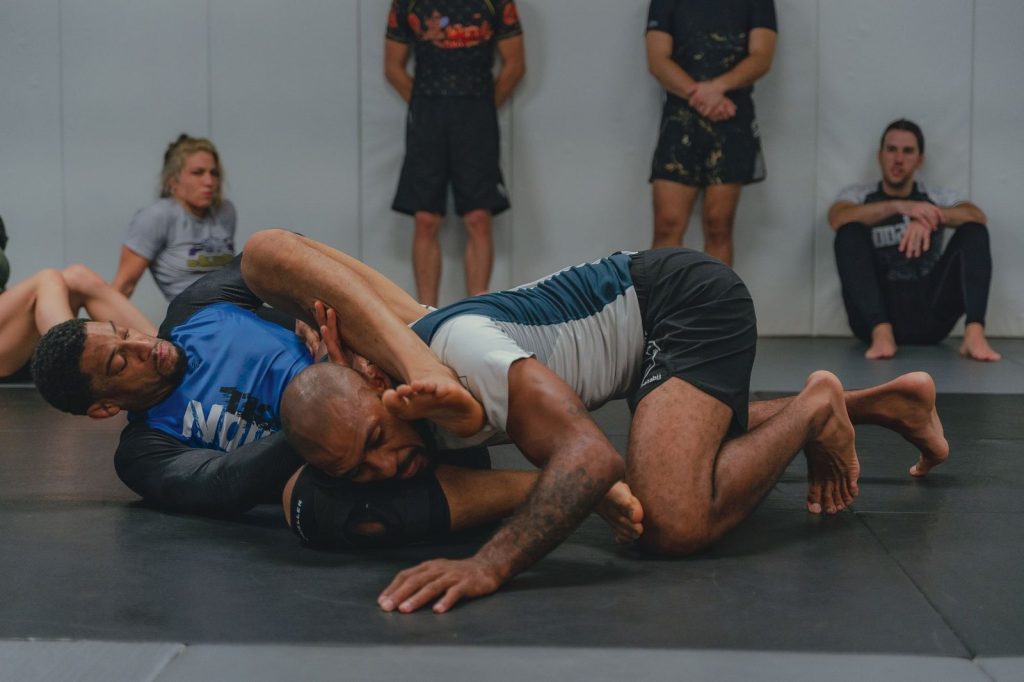
Your opponent dives for your legs. You don’t back up: you kick both legs back, feet wide, and drop your hips toward the mat. Your weight lands on their shoulders and the back of their head, their arms can no longer reach your legs, and they end up flat underneath you.
Step by step
- Spot the level change: shoulders drop, head goes below your guard line.
- Hands go to the shoulders or the back of the neck to block the entry and feel the movement.
- Legs shoot back, wide, up on the toes. The farther back, the harder they are to grab.
- Hips drop to the mat, not up in the air. This is the one beginners get wrong.
- Chest down on their back or shoulders, making them carry your weight.
One arm often goes over the shoulder and under the armpit, the whizzer, to stop them climbing back onto your legs.
After the sprawl
Back to the feet
The striker’s option. Push the head away, take a step back, and you are back in striking range while your opponent has burned energy for nothing. This is the sprawl-and-brawl style, and Chuck Liddell remains its best-known example.
Counterattack
The grappler’s option, with the opponent flat and their head under your chest:
- the front headlock, a head control that sets up several attacks;
- the guillotine, if the head stayed in front;
- spinning to the back;
- body knees or punches, within the rules.
Remember that a knee to the head of an opponent whose knees are on the mat is illegal under the Unified Rules.
Costly mistakes
| Mistake | Result |
|---|---|
| Hips up | Their arms stay under you and they finish |
| Legs too narrow | They grab one leg and switch to a single |
| Sprawling late | Their hands are already locked behind your knees |
| Looking away | You miss the level change |
| Lying flat and still | They power back up and you lose the advantage |
Timing is the hardest part: the sprawl must fire on the level change, not when they touch your legs.
Drills
- Sprawl on the clap: a partner claps, you sprawl and return to stance. 20-second rounds.
- Sprawls in shadowboxing: every fourth or fifth combination, add a sprawl.
- Partner rounds: one shoots doubles at medium speed, the other defends, switch every ten reps.
- Sprawls near the cage: same movement with your back close to the fence, which is harder and closer to a real fight.
Frequently asked questions
What is the sprawl used for in MMA?
To defend leg attacks such as the double leg and the single leg, and either stay standing or end up on top.
Does the sprawl work against the cage?
Less well, because you cannot kick your legs as far back. Against the fence it is combined with underhooks and hand fighting to escape.
Who is known for the best takedown defense?
Chuck Liddell is the name that comes up most, having built his whole career on stuffing takedowns. The UFC publishes takedown defense percentages for every fighter.