Key Takeaways
- Ground and Pound (G&P) means striking an opponent on the ground from a position of control.
- The power comes from trunk rotation and the piston effect, in addition to arm strength.
- Control before you strike is the golden rule: a poorly secured G&P leaves you open to the opponent’s submissions.
- Punches, elbows and hammer fists are the main weapons, depending on the position and the available range of motion.
- Mark Coleman, an MMA pioneer, popularized the concept in the 1990s by combining wrestling with ground strikes.
What Is Ground and Pound?
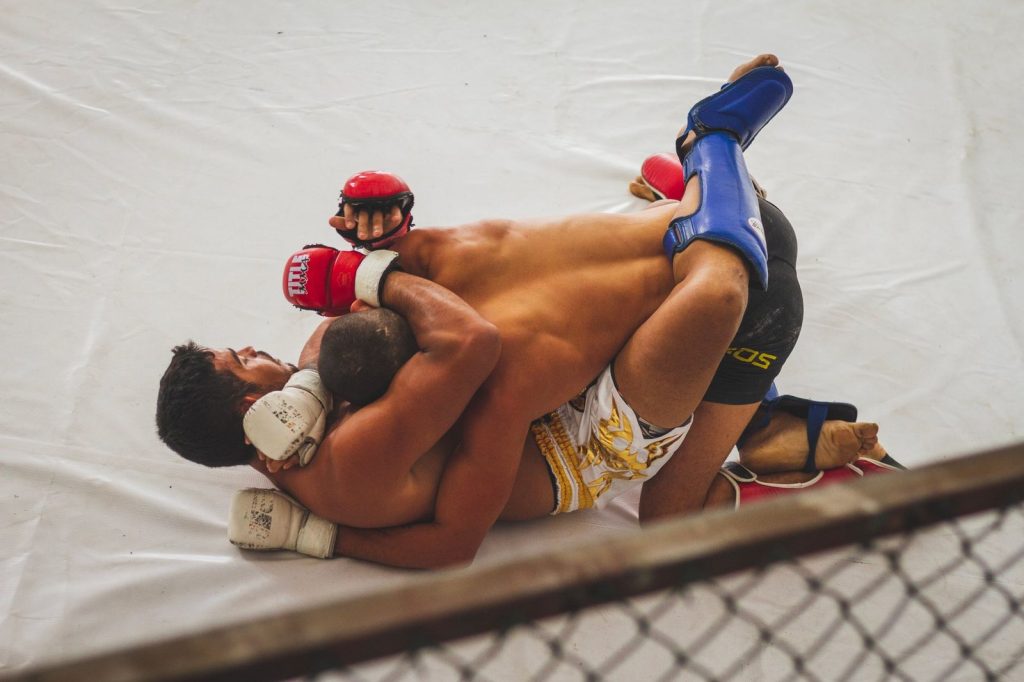
Ground and Pound (G&P for short) is the art of striking an opponent on the ground from a dominant position of control. It is one of the most distinctive dimensions of modern MMA: a discipline in its own right, born from the fusion of American wrestling and striking arts, and popularized from the earliest days of the UFC by fighters coming out of collegiate wrestling.
G&P goes well beyond simply “hitting on the ground.” It is a complete tactical system that involves managing position, choosing strikes according to the available angle, and constantly reading the opponent’s reactions: every defense opens a window to a submission, and every defended submission opens a window to strikes.
Biomechanical Principle
Striking on the ground is fundamentally different from striking on the feet. Without the ability to pivot the feet freely, power comes first and foremost from the rotation of the obliques and shoulders. The trunk becomes the main engine of every strike.
From a high posture (in mount, for example), the fighter uses a piston effect: they rise slightly and then drop down with the strike, using gravity as a force multiplier. This principle makes G&P strikes particularly heavy even with a reduced range of motion.
A second lever is often underestimated: using one hand to pull the opponent in while the other strikes creates a more violent head-on collision. The impact is amplified from both sides: the attacker moves forward, and the target is pulled toward them.
Execution
- Secure the position first. Before any strike, make sure the position of control is stable. G&P started from a precarious position leaves you open to reversals and the opponent’s submissions: safety comes before the urge to strike.
- Alternate control and striking. Use one hand to control (holding the collar, the arm, the head) and the other to strike, alternating according to the opponent’s reactions. Striking nonstop with both hands and no anchor point means giving up control.
- Read the opponent’s reactions. Each defense offers a different opportunity: a freed arm can give you an armbar or a kimura, an exposed head can leave the neck open. G&P is as much a finishing tool as a way to open up submissions.
- Transition if needed. If your current position limits effective strikes, move to a more dominant position (from half guard to mount, or from side control to the back) instead of forcing it from a bad angle.
Weapons Used by Position
Punches. The main tool from positions with enough range of motion (high mount, high posture in half guard). Straight punches and short hooks are preferred on the ground, since uppercuts are hard to throw with power.
Elbows. Especially dangerous in professional MMA. Their short range makes them usable from very tight positions (low mount, tight side control) where punches cannot travel. The damage they cause (cuts, swelling) is out of proportion to the space needed to throw them. Leaving them out is a tactical mistake.
Hammer fists. Strikes with the side of the forearm or the bottom of the closed fist, mainly used from mount. Less precise than elbows, they are effective for keeping up constant pressure.
Common Mistakes
- Prioritizing damage over control. Rushing into strikes before securing the position is the most common mistake, and the most costly. An uncontrolled opponent can reverse the situation, lock in a submission or get back up while the attacker is off balance.
- Neglecting elbows. In professional MMA, sticking only to punches means giving up a weapon that is especially effective in tight spaces. Elbows cut, cause swelling and disrupt the opponent’s vision with minimal range of motion.
- Striking nonstop without an anchor. Alternating both fists without keeping a controlling hand reduces positional stability and gives the opponent the windows they need to escape or counterattack.
Main Defenses
- Control the opponent’s arms. Tying up the attacker’s arms with overhooks, underhooks or a grip at the crook of the biceps limits the range of their strikes and opens angles for reversals or submissions.
- Do not stay flat on your back. Staying flat gives the attacker an optimal striking angle and reduces your defensive mobility. Turning onto your side, bridging, or working toward an active half guard disrupts the rhythm of the G&P.
- Get out of bad positions. The best defense is still to avoid the positions that make the opponent’s G&P easier: work on guard recovery, reversals and getting back up to limit the time spent as a target.
Fighters Who Made Their Mark With It
Mark Coleman, nicknamed “The Godfather of Ground and Pound,” the American wrestler is considered the pioneer of the concept in MMA. UFC heavyweight champion in 1997, he was the first to systematize the use of strikes from control positions on the ground, laying the foundations for a style that would revolutionize the sport.
Brock Lesnar: his extraordinary physical power and elite wrestling background allowed him to impose devastating G&P from mount, capable of ending fights in seconds once he got the opponent to the ground.
Matt Hughes, a two-time UFC welterweight champion, embodied precise and controlled G&P for a decade, combining excellent wrestling with smart strike selection.
Famous Examples in Competition
- Cain Velasquez vs. Brock Lesnar, UFC 121 (2010). Velasquez imposed G&P of rare intensity and precision, leaving Lesnar no room to breathe and ending the fight by referee stoppage. A demonstration of G&P built on flawless positional control.
- Jon Jones vs. Maurício “Shogun” Rua, UFC 128 (2011). Jones chained dominant positions and ground strikes with a versatility that revealed the full range of his arsenal to the general public. G&P was one tool among others there, used with surgical precision.
- Khabib Nurmagomedov vs. Michael Johnson, UFC 205 (2016). Khabib perfectly illustrated G&P as a tool for wearing down and opening up the opponent: his ground strikes aimed to finish and also forced the reactions that then led to submissions.
FAQ
Is Ground and Pound Allowed in All MMA Competitions?
Ground strikes with punches and elbows are allowed in the vast majority of professional MMA rule sets (UFC, Bellator, PFL, ONE, etc.). In amateur competition, some federations restrict elbows on the ground or strikes to the head on the ground: check the specific rules of the competition before preparing for it.
Why Are Elbows So Feared in G&P?
The elbow bone concentrates the force of impact on a very small surface, causing significant cuts and swelling even with minimal range of motion. Unlike punches, elbows can be used effectively in very tight spaces (low mount, close contact on the ground) where it is impossible to generate power with a fist.
What Is the Best Position for Ground and Pound?
Full mount in high posture is generally considered the most favorable position: the attacker gets an optimal striking angle, maximum stability and a clear view of the opponent’s face. Side control and half guard are also effective positions, but they require adjusting strike selection (elbows are preferred because of the reduced space).
Can Ground and Pound Open Up Submission Opportunities?
It is one of its major tactical strengths. Ground strikes force the opponent to protect their face, which often frees up the arms (an opportunity for an armbar or kimura) or the neck (an opportunity for a choke). Conversely, a defended submission attempt often brings the opponent’s limbs into positions that favor strikes. The two disciplines feed off each other.
Conclusion
Ground and Pound is one of the most complete expressions of modern MMA: it demands mastery of ground control, striking power and constant tactical reading of the opponent’s reactions. Control before you strike, use your elbows without hesitation, and stay alert to transitions into submissions: these are the three principles that set effective G&P apart from a simple exchange of blows on the ground.
Ground and pound almost always starts with a takedown. The two most commonly used are covered in detail here: the double leg and the single leg.