
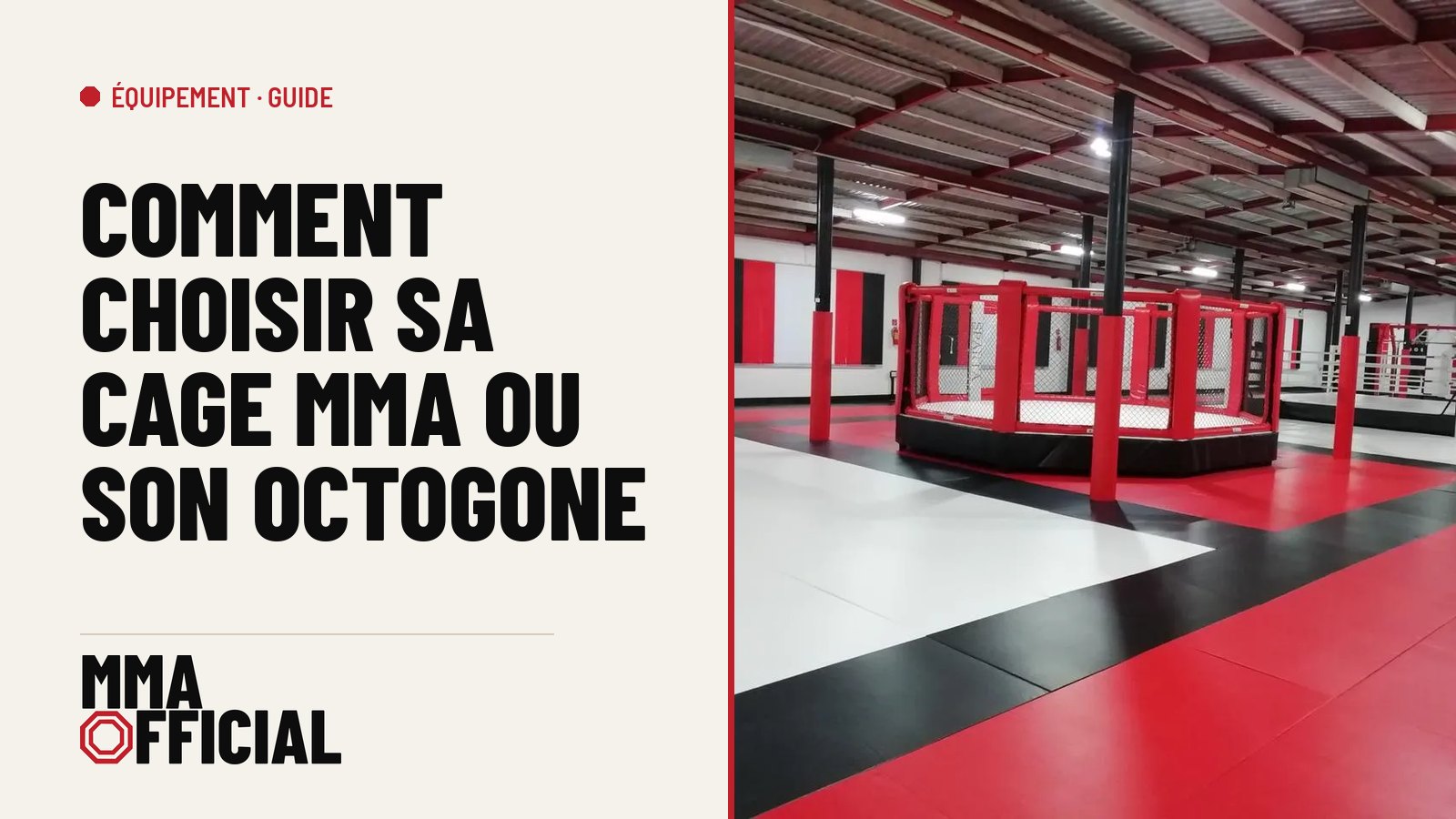
An MMA cage is not just a symbol. It is equipment that fundamentally changes how fighters compete, train and learn MMA. Compared to a boxing ring, the octagonal cage changes footwork, shapes clinch work against the fence, removes blind spots and changes both fighters’ tactical approach. Whether you are equipping a training gym, a garage or an event space, choosing the right cage is a structural decision: technically, financially and in terms of compliance. This guide gives you what you need to make the right call.
Cage vs. Octagon vs. Ring: The Real Differences
The terms “cage” and “octagon” are often used interchangeably, but they mean specific things. An “octagon” is a shape: eight equal sides. A “cage” refers to the fenced enclosure, whatever its shape (octagon, hexagon, square). A “ring” is an enclosure bounded by ropes. Here are the practical differences.
The Octagonal Cage
Popularized by the UFC starting in 1993, the octagonal cage has become the global standard for competitive MMA. Its sporting advantages are real. The absence of right angles keeps a fighter from getting passively trapped in a corner: 135-degree angles always force movement. The vertical fencing offers a solid surface for standup cage control and takedowns against the wall. The cage also removes any risk of falling out of the fighting area, which changes the tactical approach compared to a ring.
The MMA Ring
Some MMA organizations still use roped rings, particularly in Europe and Asia. The ring fundamentally changes MMA: right angles create trap zones, and the ropes let a fighter lean on them or fall through them differently. Takedowns play out differently. Many fighters who come from boxing or kickboxing prefer the ring because their positional instincts feel more natural there. For a pure MMA gym, the octagonal cage is the standard. For a multi-purpose space that also hosts kickboxing or Muay Thai, a ring still makes sense.
Hexagonal Cages and Other Shapes
Some brands offer hexagons or other cage shapes. These shapes cut manufacturing costs but noticeably change the game: six 120-degree angles create fewer neutral zones than eight 135-degree angles. For garage or training-gym use with no regulatory requirement, a hexagon can be enough. For competition affiliated with a national or international federation, the octagonal shape is generally required.
Choosing the Shape: National and International Federation Standards
If your use case is regulated (official competition, certified events), the shape is not a free choice. France’s national MMA federation (FFMMA) and the International Mixed Martial Arts Federation (IMMAF) each define precise specifications for certified cages. These specifications cover the shape (octagonal), minimum and maximum dimensions, fence height, flooring type and safety systems. Check the current rules of the federation running your event before buying anything meant for official competition: standards can change, and exact specifications should be confirmed directly with the federation.
For pure training use with no official competition, you have more freedom. But even then, matching competition standards in your training space prepares your athletes for real conditions.
6 Technical Criteria for Choosing Your MMA Cage
1: Size, Fighting Surface and Available Space
The size of an octagonal MMA cage is defined by its inner diameter. Here are the reference sizes and their corresponding floor areas.
| Size | Inner Diameter | Approx. Inner Area | Reference Use |
|---|---|---|---|
| Compact | 4 m (~13 ft) | ~11 sqm | Solo training, shadow work, small spaces |
| Standard training | 6 m (~20 ft) | ~25 sqm | Training gym, sparring, amateur competition |
| Standard pro (UFC style) | 9.1 m (~30 ft) | ~58 sqm | UFC reference size, major professional events |
To size your space, add 1.5 m on each side of the minimum inner diameter for safety zones (room for cornermen, the referee and emergency exits). A 6 m cage therefore needs a floor space of at least 9 m by 9 m. For a 9 m UFC-style cage, plan for at least 12 m by 12 m.
2: Panels, Metal Chain-Link or Vinyl Netting
The fencing defines both the cage’s look and its tactical function.
Metal chain-link: this is the competition standard. The metal mesh gives a firm surface for cage work (clinch, takedowns against the wall), does not stretch under a pinned fighter’s weight, and resists abrasion indefinitely. The edge protection needs to be checked carefully: sharp or poorly covered wire injures fighters during throws against the fence.
Vinyl netting: softer to the touch and less abrasive on the skin, vinyl netting is used on some training cages. It stretches slightly under pressure, which changes the feel of cage work. Cheaper to produce, but it ages faster under UV exposure and humidity.
For competition or serious training, quality metal chain-link with vinyl edge covering is the preferred choice. Vinyl netting works for beginner use or a tight budget.
3: Flooring, Foam and Vinyl, 5 cm Minimum
The floor of an MMA cage is safety equipment before it is comfort equipment. It absorbs falls, takedowns and impact from strikes on the mat. Sporting rules set a minimum thickness: check with your national federation for your competition level. In practice, a 5 cm floor (high-density foam plus vinyl covering) is considered the acceptable minimum for sparring and amateur competition. Some pro standards call for 10 cm.
The vinyl covering needs to be fire-rated, waterproof, non-slip and resistant to repeated abrasion. Color is often set by competition rules or by the promoter’s branding. Check the density of the foam underneath: low-density foam (under 80 kg/m³) packs down quickly and loses its shock-absorbing properties within a few months of intensive use.
4: The Tube Frame
The frame of an MMA cage is built from metal tubing that forms the vertical and horizontal structure supporting the fence panels. Galvanized steel is the reference material for its corrosion resistance and structural strength. Check the wall thickness of the tubes (given in mm): walls that are too thin flex under repeated impact and warp. The main load-bearing tubes need enough cross-section to handle the dynamic force of a fighter thrown against the fence.
Bolted connections are stronger and allow for clean disassembly. Clip or snap-together connections make setup easier but can come apart under hard impact: avoid these on cages meant for competition.
5: Demountable Setup
An MMA cage is rarely a permanent installation. Most gyms and event organizers need a cage that comes apart, travels and can be reassembled. Check the time and number of people the manufacturer specifies for setup. A well-designed 6 m cage can be set up in 2 hours with two experienced people. A poorly designed assembly system can take half a day with four people.
Also check the total weight of the disassembled cage and the volume of the shipping crates. A complete 6 m cage can weigh several hundred kilos: budget for transport (truck, storage space) in your overall costs.
6: Safety Certification and National Federation Approval
For professional and event use, two levels of certification matter.
CE marking: required in the European Union for any sports equipment sold there. It certifies that the product meets European safety standards. Equipment without CE marking should not be used in a professional or club setting in the EU.
National federation approval: to run official competitions affiliated with a national federation such as France’s FFMMA, your cage needs to meet that federation’s technical criteria. These criteria cover shape, dimensions, fencing, flooring and door-closing systems. Contact the federation directly to get the list of approved cages or the approval process for new equipment.
Budget by Use: Indicative Ranges
| Use | Recommended Format | Indicative Range | Notes |
|---|---|---|---|
| Garage / home gym | Compact 4-5 m cage, metal or vinyl fencing | Check pricing | Add electrical setup and flooring budget |
| MMA training gym | 6 m octagon, galvanized steel, 5 cm+ floor | Check pricing | Budget for delivery (weight) and installation |
| Amateur / regional event | Demountable 6 m octagon, federation-approved | Check pricing | Rental is a viable alternative to buying |
| Professional event | 9 m octagon, 10 cm floor, international/national standards | Check pricing | Stage lighting, sound and branding budgeted separately |
MMA cage prices vary widely by origin, size and options. All the ranges above should be checked directly with manufacturers and retailers. Find our updated recommendations here:
- Compact MMA cages for garages and home gyms
- 6 m octagons for training gyms
- Demountable MMA cages for events
European Manufacturers vs. Imports from Asia
The MMA cage market is dominated by two main categories of supplier: manufacturers or assemblers based in Europe, and importers of cages built in Asia (mainly China and Korea). Each option carries real advantages and real risks.
European Manufacturers
Manufacturers based in Europe (France, the UK, Germany, Spain) build cages that meet European CE standards from the design stage. After-sales support is easy to reach, replacement parts are available quickly, and sales staff know the national and IMMAF rules. The price is generally higher, but the total cost reflects regulatory compliance and ongoing technical support.
Imports from Asia
Cages imported directly from Asia can be significantly cheaper to buy. Some Asian manufacturers produce good-quality equipment, particularly for export markets. Risks to plan for: CE compliance not guaranteed if the supplier is not used to the European market, actual tube wall thickness sometimes below the advertised specs, long delivery times (6 to 12 weeks), customs and ocean freight costs to factor in, and no local after-sales support if something goes wrong.
If you are considering direct import, always ask for load-test certificates, a technical data sheet on the materials used, and reference photos of installations already completed. Never rely solely on the catalog’s marketing photos.
National Federation Rules on Approved Cages
A national MMA federation such as France’s FFMMA is the body that sets the approval criteria for competition equipment in its country. Approving a cage covers several aspects.
Shape and dimensions: octagon, with minimum and maximum inner dimensions defined (check the federation’s website: standards change, and exact specifications should be obtained directly from the federation).
Fence height: the minimum height of the enclosure is set to keep any fighter from going over the top or falling out of the cage during a throw. Rules generally call for a fence height of at least around 1.80 m (about 6 ft), but check the current rules for exact figures.
Door closing system: cage doors need to open outward and close securely during the fight. They need to open quickly in a medical emergency. Inadequate closing systems (a poorly placed latch, a door that opens inward) are common reasons for an approval to be denied.
Floor: minimum thickness, foam density, fire-rated covering. The flooring manufacturer’s certification is often required.
For any official event, contact the relevant federation ahead of time to confirm your equipment is compliant or to get the approval process for new gear. An unapproved cage used for an official competition can lead to the event being canceled and to disciplinary sanctions for the organizer.
FAQ: Frequently Asked Questions About MMA Cages
What is the difference between an octagon and an MMA cage?
An octagon is a geometric shape with eight sides: it is the name given to the fighting enclosure used by the UFC and adopted as the global standard. “MMA cage” is a generic term for any fenced enclosure used for MMA, whatever its shape (octagon, hexagon, rounded square). In everyday usage, the two terms are often used interchangeably to mean an octagonal enclosure. To be precise, an MMA cage can be octagonal, hexagonal or another shape, while an octagon specifically refers to the 8-sided shape.
Can you install an MMA cage in a garage?
Yes, provided you have enough space. A compact cage with a 4 to 5 m diameter needs a floor area of roughly 7 m by 7 m minimum (cage plus safety zones). Ceiling height should be at least 2.5 m for jumping kicks and throws. Also check the floor’s load capacity: a complete cage with flooring can weigh several hundred kilos, so a concrete slab or a solidly framed wood floor is required. Finally, plan for shock-absorbing flooring (mat or foam) under the cage if your concrete slab is not built into the cage itself.
Do you need an octagonal cage to train MMA?
No. MMA works perfectly well on a mat or in a roped ring, especially for technical training. The cage is a specialization tool: it is essential if you are preparing for competition in an organization that uses a cage, and it adds value to training by introducing cage control work. But thousands of practitioners improve just fine without one. If your budget is tight, invest first in good flooring (mats), striking gear and protective equipment, and treat the cage as a later investment.
What cage size is needed to run amateur events under a national federation?
For official competitions under a national federation, the cage’s size and features are set by the federation’s current rules. As a general rule, a 6 m inner-diameter cage is the reference for amateur and semi-professional events. But the exact specifications (dimensions, fencing, flooring, closing systems) should be checked directly with the federation: the rules change, and only the federation can confirm that a specific piece of equipment is approved for a given event.
How much does it cost to rent an MMA cage for an event?
Renting an MMA cage for an event is a serious alternative to buying for occasional organizers. Rental rates vary by cage size, rental duration, transport costs and setup/teardown fees. Prices should be checked directly with rental providers who specialize in MMA equipment: several companies offer this service with delivery, installation and pickup included. Contacting several providers and comparing quotes is the best approach for one-off events.