
Introduction: 3 Equipment Levels, 3 Different Realities
Equipping an MMA gym is not just a matter of laying down a mat and hanging a bag. It is a structured project, with constraints around space, budget, safety and use that vary enormously by setting. Before buying anything, ask a simple question: who is this gym for, and what is it built to do?
Level 1: Home / garage: a solo practitioner or a pair, limited space (20 to 50 sqm), a tight budget, no need to host the public. The goal is a functional space to train alone or with a partner, without necessarily replicating a club gym.
Level 2: Semi-pro private gym: a small setup, an independent coach or a group of practitioners, space between 80 and 200 sqm, needing to cover several disciplines (striking, grappling, conditioning). The investment needs to be durable and multi-purpose.
Level 3: Professional gym: an affiliated club, open to the public, with several coaches and enough members to justify full infrastructure. Safety standards apply, upkeep is constant and the equipment has to withstand intensive daily use.
This guide follows that progression from simplest to most complete. Each section flags what is essential, what is nice to have, and what can wait.
Flooring: The Foundation of Everything
Flooring is the first investment to make, and the most important one. A poor floor surface causes knee, ankle and hip injuries, creates mat burns on takedowns and makes ground work uncomfortable or even dangerous. It is also the item people most often wrongly try to save money on.
EVA Puzzle Mats vs. Roll-Out Mats vs. MMA Carpet
EVA puzzle mats are the most accessible and modular option. The tiles interlock without tools, move easily, and can be replaced piece by piece if damaged. Ideal for home use or a multi-purpose gym. Drawback: the seams between tiles can catch toes, and gaps widen over time if the pieces are not perfectly fitted. Foam density varies enormously between manufacturers: a cheap 1 cm EVA mat will be ineffective; aim for a minimum of 2 cm for grappling, 4 cm for heavy throws.
Roll-out mats (vinyl tatami) are the standard for serious clubs. A single piece covers the whole surface, with no seams, and a vinyl top that is easy to clean. The high-density polyurethane foam padding gives even shock absorption across the whole surface. More expensive upfront, they are noticeably more durable and offer better comfort for throws and rolls. Plan for careful handling: a 6 x 6 m mat weighs between 50 and 100 kg depending on thickness.
MMA carpet (sometimes called octagon material) is a textile covering, glued or laid loose, similar to the interior surface of competition cages. It offers good grip for standup movement but less shock absorption for grappling. It is hard to clean deeply and suits striking areas better than ground grappling areas.
Minimum Thickness by Use
- 2 cm: acceptable for light standup work, bag striking, conditioning drills. Not enough for throws and falls.
- 4 cm: the minimum for grappling, judo and moderate throws. A good compromise for a multi-purpose gym.
- 6 cm: recommended for heavy throws (judo, wrestling), backfalls and training with heavier partners. Maximum comfort, higher cost.
Calculating the Floor Area You Need
To calculate the floor area to cover, start by defining your activity zones:
- Grappling area: minimum 6 x 6 m for 2 practitioners sparring. Ideally 8 x 8 m to comfortably work with 3 or 4 pairs at once.
- Striking area: depends on the number of bags and the amount of space you want around them.
- Conditioning area: can be on hardwood or a different synthetic floor if you want to separate uses.
Add 10 to 15% to your calculated usable area to account for edges, corners and cutouts around obstacles (columns, doors). See our guide: choosing an MMA mat, a comparison and buying guide.
Floor Maintenance
An MMA gym floor should be cleaned after every session. Mats accumulate sweat, skin cells, bacteria and fungi, a source of ringworm and impetigo. Use a diluted disinfectant cleaner (neutral or mildly acidic pH) and a soft-bristle brush or a disinfectant mist spray. Avoid harsh products that degrade the vinyl surface or the EVA foam. Rinse with clean water if the product calls for it and let it dry before closing up the gym.
Striking Area
The striking area is the visible heart of any MMA gym. It is where standup training, combinations, precision work and cardio happen. Equipping this area well does not mean piling up every piece of gear that exists: it means choosing the right priorities for the space and the use.
Hanging Heavy Bag
The heavy bag is the number one piece of equipment in any striking area. It lets you work strikes at full power, punch/kick/knee/elbow combinations, long sequences and cardio. For an MMA gym, prefer a long cylindrical bag (between 120 and 150 cm) over a short boxing bag: it lets you work low kicks, body knees and spinning kicks.
The bag’s weight should be about half the weight of the heaviest practitioner. A bag that is too light swings too much, one that is too heavy does not move enough. The mounting matters: use a certified wall bracket or a ceiling beam with a 360-degree swivel hook. Always check the maximum rated load of your mount before buying. See our picks: the best heavy bags for a professional MMA gym.
Speed Bag
The speed bag is ideal for working rhythm, coordination and striking speed. It mounts on a height-adjustable wall platform. Leave 1.5 m of clearance around it. It is not a priority in limited space, but adds real value for practitioners looking to develop their striking game.
Focus Mitts and Striking Targets
Focus mitts are not gym fixtures in the strict sense, but shared equipment the gym needs enough of for classes. One pair of focus mitts per coach or training pair during class is the minimum ratio. Wall-mounted targets (fixed to a wall or a bar) allow solo precision work and are useful for warming practitioners up before group classes.
Mirrors
A wall of mirrors in the striking area is very useful so practitioners can check their guard, posture and combinations. Use safety mirrors (laminated glass or acrylic mirror) to avoid any injury risk. Recommended height: floor to ceiling, or at least 2 m above the floor. A width covering 3 to 4 m of wall is enough for most uses.
Grappling Area
The grappling area is the technical heart of the gym for BJJ, wrestling, judo and MMA ground work. Its quality directly determines practitioners’ safety during throws and ground transitions. It is not just about the floor: the training surface, any cage and the complementary equipment form one coherent setup.
Minimum Surface of 6 x 6 m
6 x 6 meters is the absolute minimum for two-person grappling sparring. Below that, practitioners constantly roll off the mat, falls happen near the edges and the risk of colliding with walls increases. For group classes with 6, 8 or 10 practitioners at once, aim for at least a 10 x 10 m area. Always leave a buffer zone of 50 cm to 1 m between the edge of the mat and the first fixed obstacle (wall, column, equipment).
Cage or Octagon: Who Needs One, and Why?
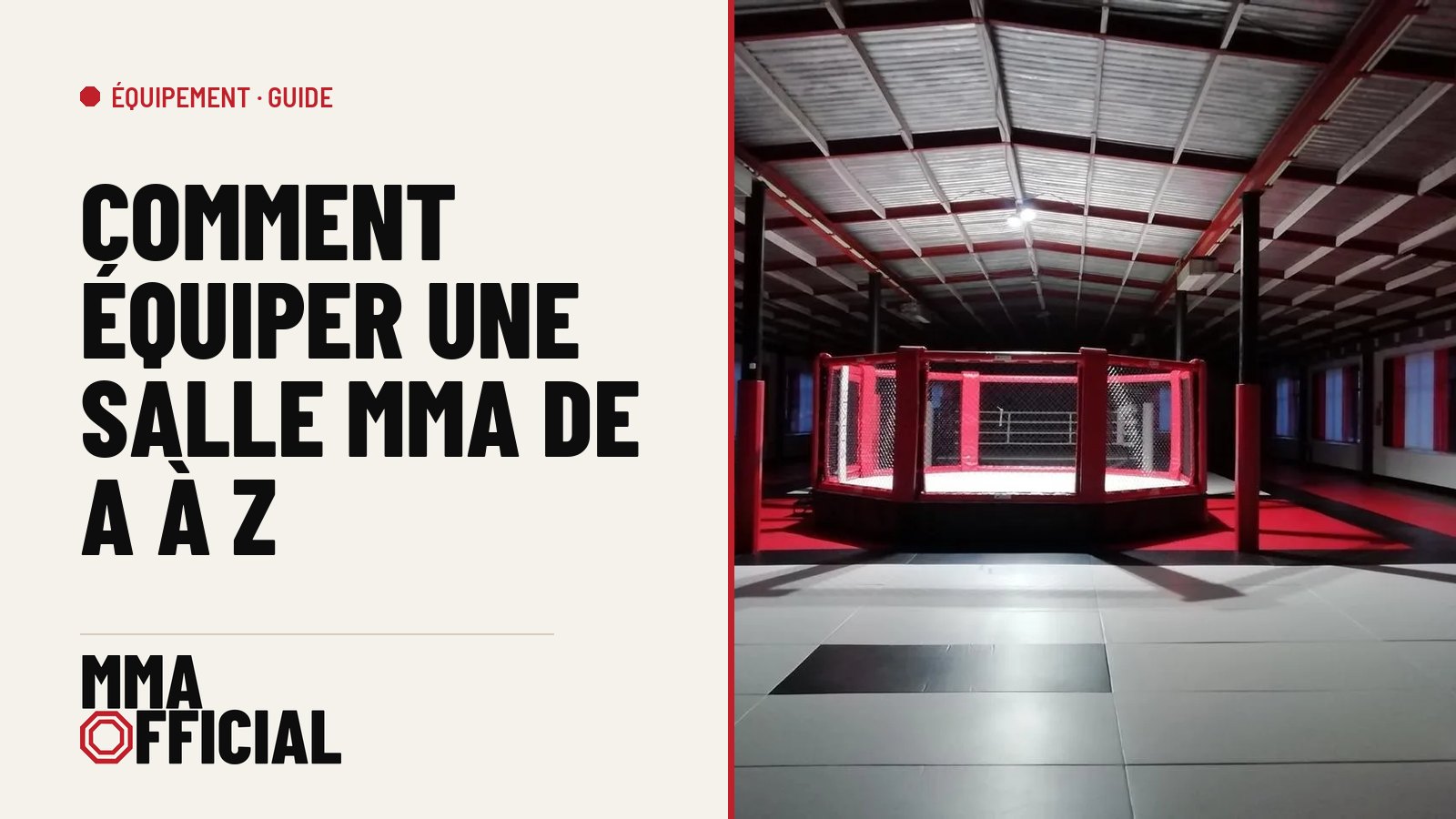
The hexagonal or octagonal cage is the signature piece of MMA equipment. It lets you work clinch against the fence, cage-assisted takedowns, cage exits and fence-specific techniques. For a club that trains competitors, it is essential. For a recreational gym or a home garage, it is a costly luxury (check pricing) that takes up a lot of space.
Modular cages (panels that can be taken apart) are an interesting alternative for multi-purpose spaces. They let you use the room differently when the cage is not set up. Make sure to reinforce the floor under the cage and use certified floor anchors to prevent any movement during intense sparring.
Wall Pads: The Alternative to a Cage When Space or Budget Is Tight
Wall pads are high-density foam panels (generally EVA or polyurethane) mounted directly on the gym walls, roughly from 0 to 2 m high. Their first function is safety: they absorb impact from throws into the wall, rolling out of the area and clinch fighting on the perimeter. But their usefulness goes well beyond simple protection.
In a gym without a cage, wall pads partially recreate fence-based fight situations: clinch against the wall, takedowns from the perimeter, defensive exits. It is not a perfect substitute for a cage (you cannot grip a wall pad the way you grip chain-link fencing) but for a club without the budget or the space for a cage, it is a serious, far cheaper solution. Professional-grade models mount on rails or industrial velcro and come off easily if the room is used for multiple purposes.
For a club gym, cover at least the two walls closest to the grappling area. A thickness of 5 to 7 cm is recommended to absorb throws. Some kits include rounded corner pieces to protect the angles, an important detail to prevent injury during rolls near the edge of the area. Price and availability should be checked against the surface you need to cover.
Grappling Dummy
The grappling dummy is a weighted training dummy for working submissions, throws and combinations alone or with a partner. It is especially useful for beginners who want to repeat techniques without needing a training partner. Jointed models let you place the limbs in realistic positions to work armlocks, chokes and control positions. Recommended weight: between 30 and 50 kg for general use. See our picks: the best MMA grappling dummies.
Strength and Conditioning Area
MMA demands complete physical preparation: strength, power, endurance, mobility, coordination. A dedicated strength and conditioning area keeps weight equipment out of the technical areas and better structures the flow of training.
The Essentials for a Conditioning Area
Pull-up bars: wall- or ceiling-mounted, essential for back, bicep and core work. A fixed ceiling bar reachable from the floor (no stool needed) is ideal. Choose a bar with multiple grips (wide, neutral, close) to vary the angles of work.
TRX / suspension straps: light, compact and versatile. They allow dozens of functional exercises (rows, core work, suspended squats, rollouts) and mount in 30 seconds on a bar or a ceiling hook. Ideal for small spaces.
Kettlebells: essential for MMA conditioning. Swings, cleans and presses, snatches, Turkish get-ups: kettlebells build explosive power, muscular endurance and joint stability in a functional way. Plan for a set of 3 to 5 different weights (25 to 70 lb depending on the practitioners) for shared use.
Jump rope: a classic tool but brutally effective for cardio, coordination and warming up before sparring. Inexpensive and compact, it should be available in several copies in any MMA gym.
Medicine balls: used for throws, rotations and dynamic core exercises. Ideal for building striking power and trunk stability. Plan for several weights (6, 10, 18, 20 lb).
Battle ropes: a 10 to 15 m rope fixed to an anchor point, used for high-intensity cardio, shoulder work and muscular endurance. Needs about 10 linear meters of floor space. Very effective for round finishers in fight camp.
Common Areas and Logistics
A functional gym is not just technical equipment. How the common areas are organized shapes how smoothly sessions run, how clean the gym stays and how comfortable all practitioners feel.
Storage: plan for lockers or shelving for personal gear (gloves, shin guards, headgear). Wall hooks for gym bags keep belongings off the floor. A rolling cart for shared gear (loaner gloves) makes managing classes easier.
Locker rooms: in a professional gym, separate men’s and women’s locker rooms with showers are nearly mandatory once you open to the public. For a home or private semi-pro gym, at minimum a space with hooks, a bench and access to a bathroom.
Whiteboard / tactics board: very useful for noting the day’s program, the techniques taught and club announcements. Place it somewhere visible from the main training area.
Sound system: a decent sound system is a real plus for classes. It helps pace the rounds, set the mood during warmups and play instructions during group drills. A simple Bluetooth setup is enough for a small gym; plan for a fixed installation in a professional gym.
Recommended Shared Equipment
A gym worthy of the name needs to be able to welcome a beginner who shows up with nothing. That means having enough shared gear, in good condition, for classes.
- Loaner gloves: at least 6 pairs of MMA gloves (10 to 12 oz) for classes. Loaner gloves wear out fast: plan to replace them yearly or every two years depending on how hard they are used.
- Disinfectant spray and wipes: accessible to everyone, at several points around the gym.
- First aid kit: mandatory in any professional sports facility. Minimum contents: bandages, sterile gauze, saline solution, antiseptic, instant ice pack.
Home Gym Budget: 3 Levels
Here are the purchase priorities and budget items for a home or garage gym, organized into three equipment levels. All prices should be checked at the time of purchase.
| Item | Essential | Comfort | Premium |
|---|---|---|---|
| Floor (4 cm EVA puzzle mat) | Check pricing | ||
| Floor (4 cm roll-out vinyl mat) | Check pricing | Check pricing | |
| Heavy bag + mount | Check pricing | Check pricing | Check pricing |
| MMA gloves | Check pricing | Check pricing | Check pricing |
| Protective kit (headgear, shin guards, cup, mouthguard) | Check pricing | Check pricing | Check pricing |
| Jump rope + medicine ball | Check pricing | Check pricing | Check pricing |
| Pull-up bar | Check pricing | Check pricing | |
| Grappling dummy | Check pricing | Check pricing | |
| Kettlebells (set) | Check pricing | Check pricing | |
| Speed bag | Check pricing | ||
| Safety mirror | Check pricing |
The golden rule: buy what lets you train properly and safely first. The floor and the bag come before the cage and the mirror. A good floor with a good bag beats a cage on an unsuitable floor, every time.
Professional Gym Budget
For a professional gym, there are more budget items and the requirements are higher. Here is a table distinguishing the essential upfront investment from what can be planned over 12 to 24 months.
| Item | Essential (Day 1) | Nice to Have (Month 6) | Can Wait (Month 12) |
|---|---|---|---|
| Vinyl mat flooring, grappling area | Yes: check pricing | ||
| MMA carpet flooring, striking area | Yes: check pricing | ||
| Heavy bags (3 to 6 units) | Yes: check pricing | ||
| Shared gloves (10+ pairs) | Yes: check pricing | ||
| Focus mitts (6 pairs) | Yes: check pricing | ||
| Strength and conditioning area (bars, rope, kettlebells) | Yes: check pricing | ||
| Cage / octagon | Yes: check pricing | ||
| Safety mirrors | Yes: check pricing | ||
| Fixed sound system | Yes: check pricing | ||
| Battle ropes | Yes: check pricing | ||
| Speed bag | Yes: check pricing | ||
| Grappling dummy | Yes: check pricing | ||
| Locker room cages | Yes: check pricing |
For professional-grade heavy bags, speed bags and shared equipment, see our guide: professional MMA gym equipment, a supplier comparison.
Practical Tips: Ventilation, Lighting, Wall Coverings
The technical aspects of a gym beyond the training gear have a direct impact on training quality and hygiene. Do not overlook them in your project.
Ventilation
A poorly ventilated MMA gym spreads skin infections, respiratory illness and bad odors. Natural ventilation (operable windows, high and low vents) is the minimum. For an enclosed space with no windows (garage, basement), a mechanical ventilation system (HVAC) is essential. The goal is to replace the air in the gym several times an hour during training. Avoid air conditioners that just recirculate air in a closed loop without filtration: they can spread bacteria and aerosols.
Lighting
Good lighting is essential for safety and performance. Sparring areas need to be well lit so fighters can see strikes and their partner’s movements. Favor neutral white LED lighting (4000 to 5000 K) with at least 500 lux of brightness at floor level. Avoid yellow or orange bulbs, which tire the eyes and make distances harder to judge. In ground work areas, protect light fixtures with guards to prevent broken glass from falls or thrown equipment.
Wall Coverings
The walls of an MMA gym take impacts, sweat splashes and repeated friction. Paint the walls with a washable paint that resists impact and moisture. In sparring areas and near the bags, padded wall covers (PVC foam panels) reduce injury risk when people roll out of the area and let the walls be used for clinch work. They should be installed between 0 and 2 m high on the walls bordering sparring areas.
FAQ: Frequently Asked Questions About Equipping an MMA Gym
What should I buy first when equipping an MMA gym on a small budget?
In order: the floor first (minimum 4 cm EVA puzzle mat), then a heavy bag with a solid mount, then personal protective gear. Without a proper floor, you cannot grapple safely. Without a bag, you cannot work your strikes alone. Everything else (cage, speed bag, kettlebells, mirrors) is a bonus that can wait.
What is the minimum space needed for a home MMA gym?
For solo training (bag work, conditioning, technique), 15 to 20 sqm are usable. To spar with a partner or drill technique in pairs, you need at least 25 to 30 sqm clear of any obstacle. Below that, rolling off the mat during throws is constant and dangerous. If you have a 20 sqm garage, focus on the striking area and ground work without standup sparring.
Is an MMA cage mandatory for a club gym?
No, it is not mandatory. Many very good MMA clubs train without a cage and produce high-level competitors. The cage is a technical training tool (clinch against the fence, cage-assisted takedowns) but not an absolute necessity. If your club regularly hosts competitors or runs events, it becomes strongly recommended. For a fitness- or hobby-oriented club, invest first in the floor, striking gear and shared equipment.
How do you maintain the mats in a professional MMA gym?
Clean the mats after every class with a disinfectant suited to sports surfaces. Dilute according to the manufacturer’s instructions, apply with a brush or a spray, rinse if needed and let dry before closing up the gym. Once a week, do a deep clean, partially taking apart puzzle tiles if you use them to clean under the seams. Regularly inspect the padding’s condition: a mat that has lost its shock absorption should be replaced, not just cleaned. Always use pH-neutral products so you do not degrade the vinyl surface or the EVA foam.
What equipment is actually needed for group classes?
For full MMA group classes, the functional minimum is: a quality floor covering the whole training area, one heavy bag per group of 3 to 4 practitioners, enough shared gloves (one pair per two people), focus mitts (one pair per coach) and a first aid kit. With that, you can run a complete MMA class. The cage, mirrors and conditioning equipment improve the quality and the experience, but are not blockers to getting started.