Key Takeaways
- The triangle choke is a blood choke applied with the legs, targeting the carotid arteries.
- It is mainly set up from closed guard, but also from mount or as a flying triangle.
- The legs must form a triangle around the opponent’s head and one arm, which gives the technique its name.
- Anderson Silva, Royce Gracie and Stefan Struve are among its most iconic users in MMA.
- Many transitions are possible from the triangle: kimura, armbar, omoplata, ground and pound.
What Is the Triangle Choke?
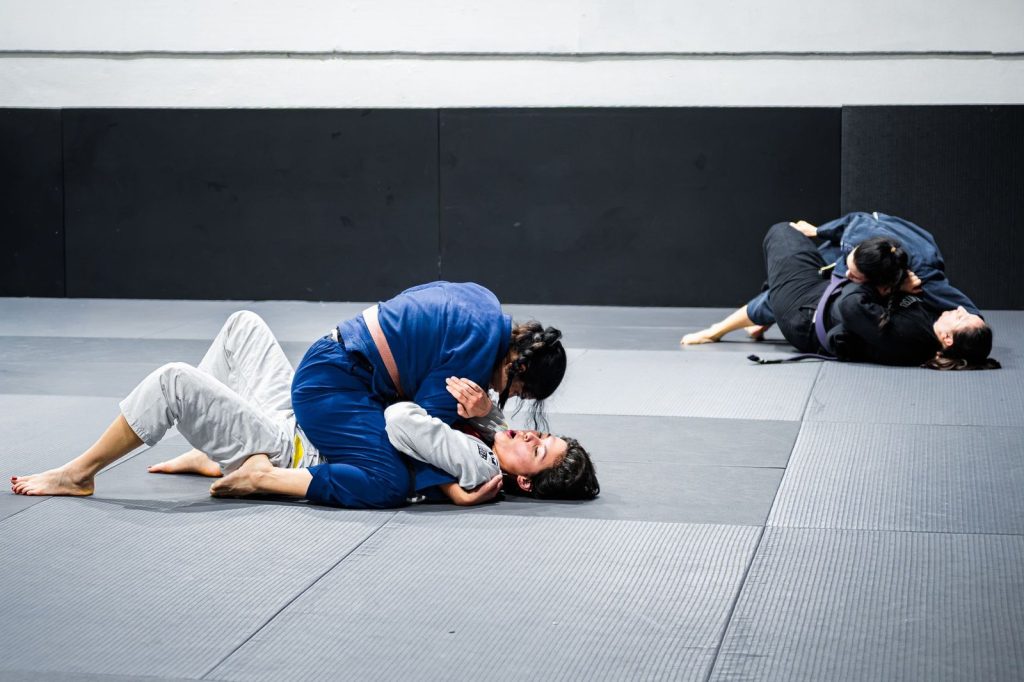
The triangle choke, called Sankaku Jime in Japanese, is a choke applied exclusively with the legs. The practitioner traps the opponent’s head and one arm inside a triangle formed by both legs, compressing the carotid arteries. Unlike chokes applied with the hands, the pressure comes from the weight and power of the lower limbs: the technique does not require much grip strength, which makes it accessible to a wide range of body types.
In competition, the triangle choke can force a submission within seconds, or even cause a loss of consciousness if the opponent resists too long. It is also feared for its ability to generate multiple offensive transitions from the same position.
Biomechanical Principle
The triangle choke is a blood choke that works on circulation, with no pressure on the airway. The practitioner’s legs compress the carotid arteries on both sides of the opponent’s neck: on one side with the thigh, and on the other with the opponent’s own arm, which is trapped inside. This double compression cuts off the flow of oxygenated blood to the brain, causing a loss of consciousness within 8 to 15 seconds if the choke is applied correctly.
The effectiveness of the technique depends on the angle formed between the thigh and the calf: the tighter this angle, the greater the pressure on the carotids. That is why locking the foot behind the back of the other knee is a non-negotiable step.
Execution From Closed Guard
- Trap the head and one arm. From closed guard, open your legs and reposition them to trap the opponent’s head and one arm between your thighs. Only one arm should be inside the triangle; the other stays outside.
- Lock the triangle. Lock one foot behind the back of the other knee. This lock is essential: it reduces the space the opponent has to escape and closes the compression angle.
- Control the head. Grab the opponent’s head with one hand to keep them from posturing up, and grab your own foot with the other hand to reinforce the lock.
- Finish. Lift your hips while squeezing your legs to increase the pressure on the carotids. The hip movement amplifies the pressure well beyond what leg strength alone could produce.
Note: from mount, the logic stays the same but the entry angle changes: the practitioner shifts sideways to bring one leg across the front of the opponent’s throat. The flying triangle, a spectacular variation, starts from a standing position and requires advanced mastery of timing.
Common Mistakes
- Not closing the triangle. Forgetting to place the foot behind the back of the knee leaves enough space for the opponent to free their head or roll out. The lock is the foundation of everything.
- Squeezing too early. Applying pressure before securing a solid position (head centered, arm isolated, lock in place) leads to a “loose” triangle that the opponent can break with little effort.
- Forcing the triangle. If the position does not close, insisting is a tactical mistake. The triangle is an offensive hub: ground and pound, kimura, armbar and omoplata are all possible options from the same leg position.
Main Defenses
- Bring the second arm inside. Bringing the outside arm inside the triangle recreates closed guard: the choke threat disappears because carotid compression is no longer possible without an isolated arm.
- Straighten your back immediately. Do not let the opponent pull your head down. A straight back reduces the compression angle and gives you time to find an escape.
- Stand up and stack. By standing up and using your body weight to stack the opponent on the ground, you reduce their hip mobility and limit their ability to finish the choke.
Notable Variations
Kimura transition. From the triangle, if the opponent tries to free their head by pushing with their free arm, the kimura grip on that arm comes naturally, creating a simultaneous double threat.
Omoplata transition. By pivoting the body 180° while keeping the leg on the opponent’s shoulder, you switch from the triangle to the omoplata, a shoulder submission by external rotation that often surprises an opponent busy defending the initial triangle.
Fighters Who Made Their Mark With It
Anderson Silva, “The Spider,” showed that the triangle choke could be launched from situations of extreme danger, as in his first fight against Chael Sonnen, when he submitted his opponent at the end of the fifth round while clearly trailing on the scorecards.
Royce Gracie, an MMA pioneer and BJJ ambassador, popularized the triangle choke in the early UFC events, proving that a lighter fighter could submit much bigger opponents through technique.
Stefan Struve, the Dutch heavyweight, used his unusual build to launch triangles from unusual angles, showing that the technique adapts to every body type.
Famous Examples in Competition
- Anderson Silva vs. Chael Sonnen I, UFC 117 (2010). Silva, dominated for four and a half rounds, turned the fight around by submitting Sonnen with a triangle choke in the final moments of the bout. One of the most memorable comebacks in UFC history.
- Nate Diaz vs. Kurt Pellegrino, UFC Fight Night 13 (2008). Diaz showed the fluidity of his BJJ by chaining ground control into a triangle choke with the economy of movement typical of his style.
- Paul Craig vs. Magomed Ankalaev, UFC Fight Night 127 (2018). Craig submitted Ankalaev with a triangle choke in the very last second of the fight, from an unfavorable position, an example that became a reference for the constant danger a BJJ fighter poses.
FAQ
Is the Triangle Choke Allowed in All MMA Competitions?
Yes, in almost all professional and amateur MMA rule sets. In BJJ, it is allowed at every belt level, including beginners. In competitive judo (IJF), leg techniques on the ground have been subject to successive restrictions; Sankaku Jime nevertheless remains allowed in many national federations.
What Is the Difference Between a Blood Choke and an Air Choke?
A blood choke compresses the carotid arteries and cuts off the flow of oxygenated blood to the brain; it works within seconds and does not cause immediate pain. An air choke compresses the trachea and prevents breathing; it is painful, slower to take effect and generally less effective in competition. The triangle choke is a blood choke.
Can You Apply a Triangle Choke on a Bigger Opponent?
Yes, and it is one of the technique’s major strengths. The compression angle comes from the position of the legs, with no need for brute strength. Royce Gracie demonstrated this in the early UFC events against much heavier opponents. However, against an opponent with a very thick neck or broad shoulders, closing the triangle requires a more precise angle adjustment.
What Transitions Are Possible From the Triangle Choke?
The triangle is a particularly rich offensive hub: armbar (arm lock on the isolated arm), kimura (if the opponent pushes with their free arm), omoplata (180° pivot), and ground and pound (strikes on the ground from the top position). This versatility makes it a feared position even when the direct finish is blocked.
What Is the Flying Triangle?
The flying triangle is a variation launched from a standing position: the practitioner jumps and wraps their legs around the opponent’s head and one arm in midair, before landing on the ground in triangle position. Spectacular as it is, this variation requires perfect timing and advanced mastery of ground technique. It remains rare in professional MMA because of the risk of being exposed to strikes during the aerial phase.
Conclusion
The triangle choke is one of the most complete submissions in grappling: biomechanically effective, versatile in its transitions, and applicable regardless of the physical balance of power. Mastering it requires a precise understanding of the leg lock and the compression angle, two technical details that make all the difference between a solid triangle and a position the opponent can break without effort.